Mtp Kit: Uses, Safety, Side Effects & When To Consult A Doctor
Medical termination of pregnancy has become safer and more accessible due to modern medicines and better medical guidelines. One of the most commonly prescribed
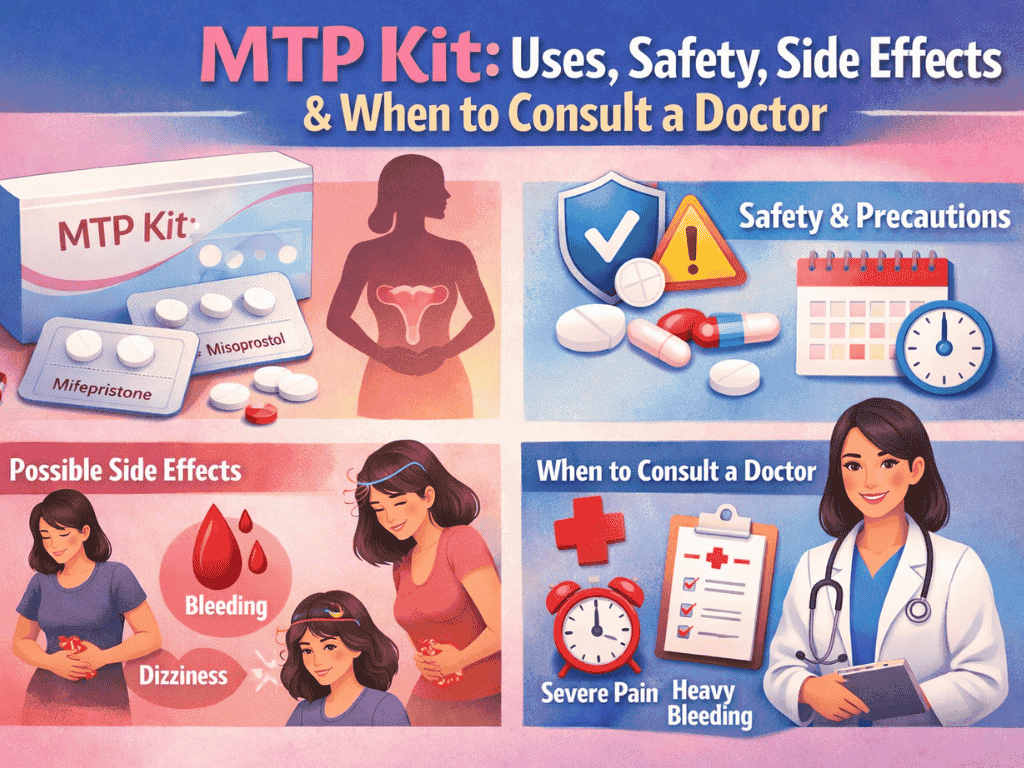
Quickobook EditorialGeneral health information — not yet medically reviewed
This article is for health awareness only. It does not replace a medical consultation. For emergency symptoms, visit the nearest emergency department.
1What this means
Medical termination of pregnancy has become safer and more accessible due to modern medicines and better medical guidelines. One of the most commonly prescribed medicines for early pregnancy termination is the MTP Kit . It is widely used under medical supervision to terminate early pregnancies safely and effectively.
2Causes and risk factors
However, despite its common usage, many people still have questions about how it works, when it should be used, its safety, and when medical help is necessary . Misunderstandings or misuse can lead to complications, which is why awareness and proper medical guidance are extremely important.
3Symptoms to notice
This comprehensive guide explains everything you need to know about MTP Kit, including its uses, safety precautions, possible side effects, and when you must consult a doctor .
Get urgent care if symptoms are severe
Severe pain, breathing difficulty, fainting, bleeding, confusion or rapidly worsening weakness should be treated as urgent.
4Tests and diagnosis
What is MTP Kit The MTP Kit (Medical Termination of Pregnancy Kit) is a combination of two medicines used to terminate early pregnancy without surgery. It is usually prescribed during the first trimester of pregnancy , generally up to 9 weeks (63 days) from the first day of the last menstrual period .
5Care and next steps
The kit typically contains two medicines:
6Care and next steps
Mifepristone
7Care and next steps
Misoprostol
8Care and next steps
These medicines work together to terminate pregnancy safely.
9Care and next steps
How MTP Kit Works The process involves two steps:
10Care and next steps
Step 1: Mifepristone Tablet
11Care and next steps
Mifepristone blocks the hormone progesterone , which is essential for maintaining pregnancy. When progesterone is blocked:
12Care and next steps
The uterine lining begins to break down
13Care and next steps
The pregnancy stops developing
14Care and next steps
The cervix begins to soften
15Care and next steps
This tablet is usually taken first.
16Care and next steps
Step 2: Misoprostol Tablets
17Care and next steps
After 24–48 hours, Misoprostol tablets are taken.
18Care and next steps
Misoprostol causes:
19Care and next steps
Uterine contractions
20Care and next steps
Opening of the cervix
21Care and next steps
Expulsion of pregnancy tissue from the uterus
22Care and next steps
This step results in bleeding and cramping similar to a heavy menstrual period or miscarriage .
23Care and next steps
Effectiveness of MTP Kit When used correctly under medical supervision, the MTP kit is 95–98% effective in terminating early pregnancy.
24Care and next steps
If the medication does not completely terminate the pregnancy, additional treatment such as repeat medication or a minor surgical procedure may be required.
25Care and next steps
Important Note Although MTP kits are widely available, self-medication without medical consultation is strongly discouraged . A doctor must confirm:
26Care and next steps
Pregnancy duration
27Care and next steps
Whether the pregnancy is located inside the uterus
28Care and next steps
Any health conditions that could make the medicine unsafe
29Care and next steps
When MTP Kit is Prescribed Doctors prescribe an MTP kit for several medical and personal reasons. The decision is always made after evaluating the patient's health, pregnancy duration, and medical history.
30Care and next steps
1. Early Unwanted Pregnancy The most common reason for prescribing an MTP kit is termination of an unwanted early pregnancy .
31Care and next steps
If a woman does not wish to continue the pregnancy and it is within the safe gestational limit (usually up to 9 weeks), medical abortion using an MTP kit is considered a safe option.
32Care and next steps
2. Contraceptive Failure Sometimes pregnancy occurs even after using contraceptives such as:
33Care and next steps
Condoms
34Care and next steps
Oral contraceptive pills
35Care and next steps
Intrauterine devices (IUDs)
36Care and next steps
In such cases, doctors may prescribe an MTP kit to terminate the pregnancy early.
37Care and next steps
3. Health Risks to the Mother Pregnancy may sometimes pose health risks to the mother , especially if she has conditions such as:
38Care and next steps
Severe heart disease
39Care and next steps
Kidney disease
40Care and next steps
Severe anemia
41Care and next steps
Certain chronic illnesses
42Care and next steps
In such situations, doctors may recommend medical termination.
43Care and next steps
4. Fetal Abnormalities If early diagnostic tests detect serious fetal abnormalities , doctors may suggest medical termination depending on the stage of pregnancy.
44Care and next steps
5. Pregnancy After Sexual Assault Medical termination may also be recommended in cases of pregnancy resulting from sexual assault , following legal and medical guidelines.
45Care and next steps
Gestational Limit for MTP Kit Most doctors prescribe the MTP kit only if the pregnancy is within:
46Care and next steps
Up to 9 weeks (63 days)
47Care and next steps
After this period, other medical or surgical options may be considered.
48Care and next steps
Medical Evaluation Before Prescription Before prescribing an MTP kit, a doctor may recommend:
49Care and next steps
Ultrasound scan
50Care and next steps
Pregnancy confirmation test
51Care and next steps
Blood tests
52Care and next steps
Medical history review
53Care and next steps
This ensures that the medicine is safe and appropriate.
54Care and next steps
Safety Precautions While the MTP kit is generally safe when used correctly, certain precautions must be followed to avoid complications.
55Care and next steps
1. Confirm Pregnancy Duration MTP kits are meant for early pregnancies only . Using them after the recommended period can lead to incomplete abortion or excessive bleeding.
56Care and next steps
An ultrasound helps determine the exact gestational age .
57Care and next steps
2. Rule Out Ectopic Pregnancy An ectopic pregnancy occurs when the embryo grows outside the uterus, usually in the fallopian tube.
58Care and next steps
MTP kits do not work for ectopic pregnancies and can be dangerous if taken unknowingly.
59Care and next steps
Therefore, a doctor must confirm that the pregnancy is inside the uterus .
60Care and next steps
3. Follow the Correct Dosage Taking incorrect doses or using the medicine incorrectly can cause:
61Care and next steps
Incomplete abortion
62Care and next steps
Severe bleeding
63Care and next steps
Infection
64Care and next steps
Always follow the exact dosage and timing prescribed by a doctor .
65Care and next steps
4. Be Prepared for Bleeding Bleeding is a normal part of the abortion process.
66Care and next steps
It usually begins within a few hours after taking Misoprostol and may last 7–14 days .
67Care and next steps
However, if bleeding becomes excessively heavy, medical attention is necessary.
68Care and next steps
5. Avoid Certain Medicines Some medications may interfere with MTP kit effectiveness or increase complications.
69Care and next steps
Examples include:
70Care and next steps
Blood thinners
71Care and next steps
Steroids
72Care and next steps
Certain anti-inflammatory drugs
73Care and next steps
Always inform your doctor about any ongoing medication .
74Care and next steps
6. Avoid Alcohol and Smoking Alcohol and smoking may increase health risks during the abortion process and should be avoided.
75Care and next steps
7. Arrange Medical Support It is recommended to:
76Care and next steps
Stay at home
77Care and next steps
Have someone nearby for support
78Care and next steps
Keep emergency contact numbers ready
79Care and next steps
8. Follow-Up Appointment Doctors usually recommend a follow-up visit within 1–2 weeks to confirm that the abortion is complete.
80Care and next steps
This may include:
81Care and next steps
Ultrasound
82Care and next steps
Physical examination
83Care and next steps
Pregnancy test
84Care and next steps
Skipping the follow-up may result in unnoticed complications.
85Care and next steps
Possible Side Effects of MTP Kit Like all medicines, the MTP kit may cause some side effects. Most of these are temporary and resolve on their own.
86Care and next steps
Common Side Effects These are expected during the abortion process:
87Care and next steps
Heavy bleeding
88Care and next steps
Abdominal cramps
89Care and next steps
Nausea
90Care and next steps
Vomiting
91Care and next steps
Diarrhea
92Care and next steps
Fever
93Care and next steps
Chills
94Care and next steps
Fatigue
95Care and next steps
These symptoms typically last for a few hours to a couple of days .
96Care and next steps
Moderate Side Effects Some women may experience:
97Care and next steps
Dizziness
98Care and next steps
Headache
99Care and next steps
Breast tenderness
100Care and next steps
Mild fever
101Care and next steps
Weakness
102Care and next steps
These symptoms usually improve within 24–48 hours .
103Care and next steps
Serious Side Effects (Rare) Although uncommon, serious complications may occur.
104Care and next steps
These include:
105Care and next steps
Excessive bleeding
106Care and next steps
Severe abdominal pain
107Care and next steps
High fever
108Care and next steps
Infection
109Care and next steps
Incomplete abortion
110Care and next steps
Allergic reactions
111Care and next steps
Immediate medical help is required if these symptoms occur.
112Care and next steps
When to Consult a Doctor While mild symptoms are normal, certain warning signs require immediate medical attention.
113Care and next steps
1. Excessive Bleeding Seek medical help if:
114Care and next steps
You soak more than two large sanitary pads per hour for two consecutive hours
115Care and next steps
Bleeding continues heavily for many hours
116Care and next steps
This could indicate severe bleeding or incomplete abortion.
117Care and next steps
2. Severe Abdominal Pain Cramping is normal, but intense or persistent pain may signal complications.
118Care and next steps
3. High Fever A fever above 38°C (100.4°F) lasting more than 24 hours may indicate infection.
119Care and next steps
4. Foul-Smelling Vaginal Discharge This can be a sign of uterine infection .
120Care and next steps
5. No Bleeding After Misoprostol If no bleeding occurs within 24 hours of taking Misoprostol, the medication may not be working.
121Care and next steps
6. Continued Pregnancy Symptoms If symptoms such as breast tenderness, nausea, or fatigue continue for weeks , the pregnancy may still be ongoing.
122Care and next steps
7. Feeling Extremely Weak or Dizzy Severe weakness or fainting may indicate excessive blood loss .
123Care and next steps
Immediate medical care is necessary in such cases.
124Care and next steps
Doctor Consultation Consulting a doctor before taking an MTP kit is extremely important for safety and effectiveness.
125Care and next steps
A medical professional can:
126Care and next steps
Confirm pregnancy
127Care and next steps
Determine gestational age
128Care and next steps
Check for ectopic pregnancy
129Care and next steps
Evaluate overall health
130Care and next steps
Provide proper dosage instructions
131Care and next steps
Who Should Avoid MTP Kit Doctors may advise against using MTP kits if a woman has:
132Care and next steps
Ectopic pregnancy
133Care and next steps
Bleeding disorders
134Care and next steps
Chronic adrenal failure
135Care and next steps
Long-term steroid use
136Care and next steps
Allergy to the medicines
137Care and next steps
Severe anemia
138Care and next steps
Certain medical conditions
139Care and next steps
In such cases, alternative treatment options may be recommended.
140Care and next steps
Importance of Medical Guidance Medical supervision ensures:
141Care and next steps
Safe abortion
142Care and next steps
Reduced complications
143Care and next steps
Proper follow-up care
144Care and next steps
Self-medication without medical consultation can increase health risks.
145Care and next steps
FAQs 1. Is MTP Kit safe? Yes, when used under medical supervision during early pregnancy, the MTP kit is considered safe and highly effective .
146Care and next steps
2. How long does bleeding last after taking MTP Kit? Bleeding usually starts within 4–6 hours after Misoprostol and may last 7–14 days , although lighter spotting may continue longer.
147Care and next steps
3. Is the abortion process painful? Cramping is common and may feel similar to strong menstrual cramps . Doctors may prescribe pain relief medication if necessary.
148Care and next steps
4. Can MTP Kit fail? Yes, although rare, the medication may fail in some cases. A follow-up checkup helps confirm whether the abortion was successful.
149Care and next steps
5. Do I need an ultrasound after taking MTP Kit? Yes. A follow-up ultrasound helps ensure that the pregnancy has been completely terminated.
150Care and next steps
6. Can I become pregnant again after using MTP Kit? Yes. Fertility can return quickly, sometimes within a few weeks . Proper contraception should be discussed with a doctor.
151Care and next steps
7. Can MTP Kit affect future fertility? When used correctly under medical supervision, MTP kits do not affect future fertility .
152Care and next steps
Conclusion The MTP Kit is a safe and effective medical option for terminating early pregnancy when used correctly and under proper medical supervision. It works by combining two medicines that stop the pregnancy and help the uterus expel the pregnancy tissue naturally.
153Care and next steps
While the medication is widely used, it is important to remember that medical consultation, proper dosage, and follow-up care are essential for safety . Understanding possible side effects and recognizing warning signs can help prevent complications.
154Care and next steps
If you are considering medical termination of pregnancy, always consult a qualified healthcare professional to ensure that the procedure is safe and appropriate for your health condition.
155Care and next steps
Proper awareness, responsible use, and medical guidance can make the process safe, informed, and manageable .
Quick symptom self-check
Use this as a simple prompt before consulting. It is not a diagnosis.